
A Guide to Family Fitness Activities That Stick
The best family workout usually does not look like a workout. It looks like kids racing to the next obstacle, parents trying a move they have not attempted in years, and everyone laughing after a missed landing. This guide to family fitness activities is built around that idea: movement sticks when it feels like a challenge you want to take on together.
For busy families, the goal is not to build a perfect schedule or turn every afternoon into boot camp. It is to create repeatable moments of movement that build strength, confidence, coordination, and connection. A little friendly competition helps, too.
Start With Activities That Feel Like Play
Children rarely get excited about exercising for the sake of exercise. Adults are not always thrilled by repetitive workouts either. The sweet spot is an activity with a clear mission: make it across the room without touching the floor, beat your previous time, carry the “supplies” to the finish line, or learn a new skill together.
Obstacle-style play works especially well because every family member can choose a level that fits. One child might crawl under a table while an older sibling jumps over a low hurdle. A parent can focus on balance, grip strength, or simply completing the course without stepping off. Everyone is moving, but no one has to be the best athlete in the room.
Use what you already have. Couch cushions can become stepping stones. Painter’s tape can make a balance line across the floor. A playground can become a circuit of climbing, hanging, sprinting, and walking. Keep the setup safe, stable, and age-appropriate, then let imagination do the heavy lifting.
Build a Family Fitness Routine Around Real Life
The routine that works is the one your family can repeat. A 20-minute movement session twice a week is far more valuable than a huge plan that disappears after one Saturday. Pick times that already make sense, such as after school, before dinner, or on weekend mornings.
Give the activity a simple name. “Tuesday Ninja Challenge” feels more exciting than “family exercise.” “Saturday Park Mission” creates something to anticipate. The name does not have to be clever. It just needs to signal that this is a shared event, not another chore.
It also helps to rotate who chooses the challenge. Let a younger child select the animal walks, let a teen pick a basketball shooting contest, and let a parent choose a neighborhood walk with hills. When everyone gets a turn to lead, participation feels more fair and resistance drops.
Keep the first goal small
Start with a finish line your family can actually reach. Try 15 to 30 minutes, including a few minutes to warm up. A short session might include a fast walk, a backyard obstacle course, a few rounds of tag, and a stretch before heading inside.
As fitness improves, add difficulty instead of immediately adding lots of time. Make the balance line narrower. Add a second lap. Ask everyone to hold a hang for a few more seconds. Small progress keeps the challenge exciting without making it overwhelming.
Choose Activities That Train More Than One Skill
The strongest family activities do more than burn energy. They help kids and adults practice the physical skills that make everyday movement easier and sports more enjoyable. Think of fitness as a combination of strength, endurance, mobility, balance, coordination, and confidence.
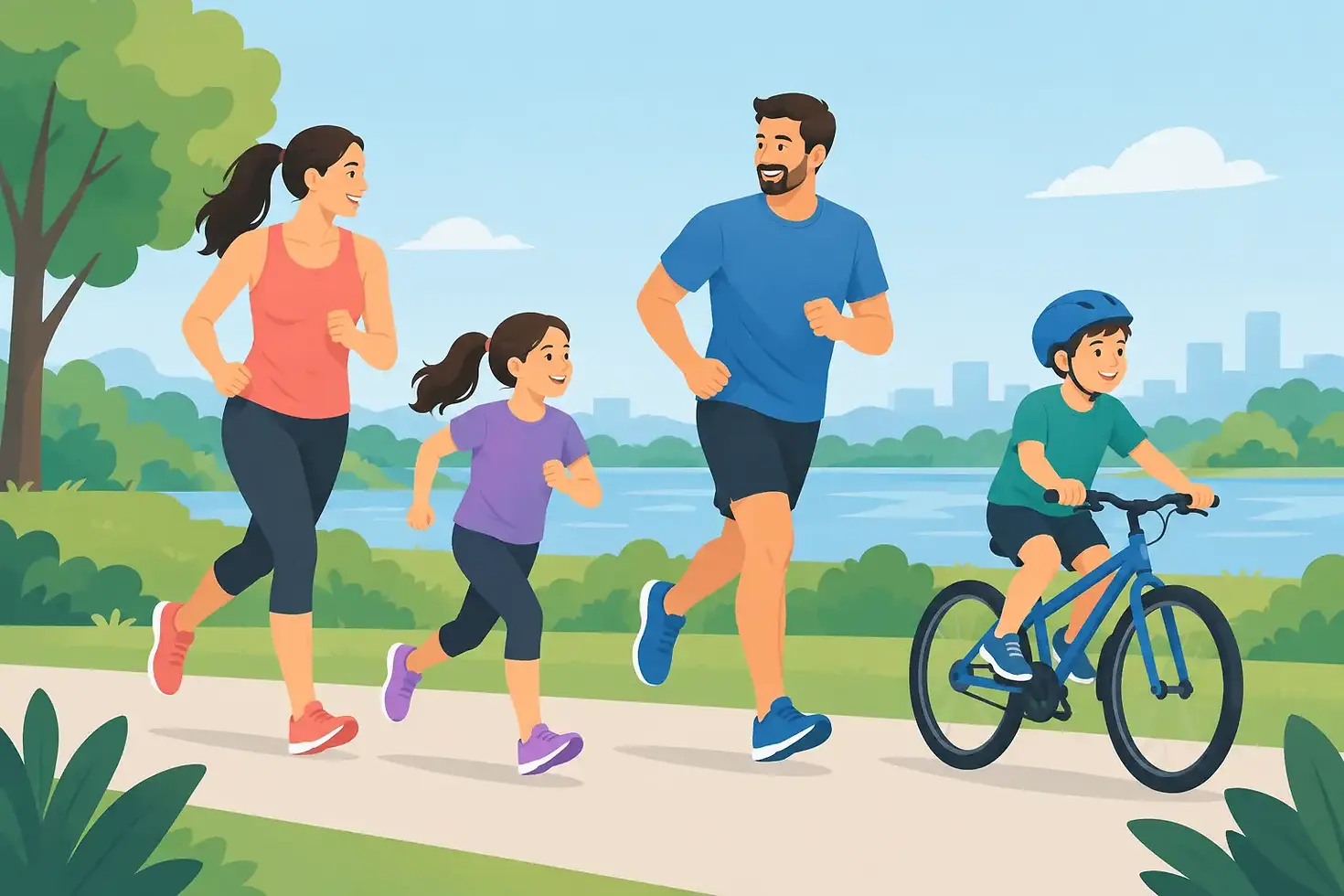
Walking or biking as a family builds endurance, especially when you choose varied terrain. Tag, relay races, and dance games develop speed and coordination. Climbing playground structures challenges grip and upper-body strength. Yoga-inspired poses can improve body awareness and balance, while a simple game of catch teaches tracking, timing, and quick reactions.
Obstacle courses bring many of these skills together. Crawling, jumping, hanging, balancing, and climbing ask the body to solve problems in motion. That is why they are a powerful option for families who get bored with standard workouts. The course can change every time, but the body keeps learning.
At Go Ninja, families can experience this kind of challenge in an environment built for ninja-style movement. For Antelope Valley parents who want something more exciting than another treadmill session, obstacle training can turn an active outing into a confidence-building win.
Make It Competitive Without Making It Stressful
A little competition can get everyone moving. Too much can make the activity feel like a test, especially for kids who are less coordinated or still building confidence. The trick is to compete against a previous effort, a clock, or a shared family goal rather than always against one another.
Try challenges like “Can we complete 50 jumping jacks as a team?” or “Can everyone improve their balance time by five seconds?” Give each person a version of the activity they can handle. A preschooler might hop over a line while an older child jumps over a cone. Both should get to celebrate finishing.
When siblings are involved, create roles that matter beyond speed. One person can be the timer, another can design the next obstacle, and someone else can be the official cheer captain. This keeps the focus on effort and teamwork rather than who has the most natural athletic ability.
Praise the right things
Celebrate persistence, smart choices, and willingness to try again. Say, “You kept going after that miss,” or “Your balance was stronger that round.” Those comments build the kind of confidence that carries into school, sports, and new experiences.
Avoid turning every activity into a lesson about weight, appearance, or earning food. Family fitness is about what bodies can do: run, climb, carry, balance, recover, and improve. That message gives children a healthier reason to stay active as they grow.
Plan for Different Ages and Energy Levels
Family activities work best when they have built-in options. A toddler, a middle-schooler, and an adult should not be expected to perform the same task in the same way. They can still be part of the same mission.
For younger children, focus on short bursts and simple directions. Animal walks, scavenger hunts, dancing, and playground play are usually enough. Older kids often enjoy skill challenges, timed courses, jump rope, basketball, biking, or climbing. Teens may respond well when they have more autonomy, such as choosing the music, designing a circuit, or setting a personal training goal.
Adults should participate whenever possible. You do not need to perform every move perfectly. In fact, letting your kids see you try, miss, laugh, and try again sends a powerful message. Fitness is not something you graduate from. It is a practice.
Some days, the best choice is low-impact movement. Take a longer walk, play an easy game outside, or do a mobility routine in the living room. Pushing hard every time can lead to burnout. Consistency matters more than intensity, and rest is part of getting stronger.
Remove the Friction Before It Starts
The biggest barriers are usually practical: shoes are missing, everyone is hungry, the weather changes, or the plan feels too complicated. Solve those problems before they derail the activity. Keep a small bag with water, sunscreen, and comfortable shoes near the door. Have a backup indoor challenge ready for hot, windy, or rainy days.
Put phones aside for the activity, unless one is being used for music or a timer. Twenty focused minutes of active family time is more memorable than an hour where everyone is half-participating. Take a photo at the end if you want, then get back to living the moment.
Most of all, do not wait for motivation to arrive. Start with a tiny challenge and let momentum build. The first lap around the block can become a race to the next corner. A few cushions on the floor can become a full mission. One family member saying, “Let’s try it,” can change the energy of the whole day.
Your family does not need a flawless fitness plan. You need a reason to move together, a challenge that feels possible, and enough fun that everyone wants another round. Set the course, cheer loudly, and see what your crew can overcome next.


Comments