
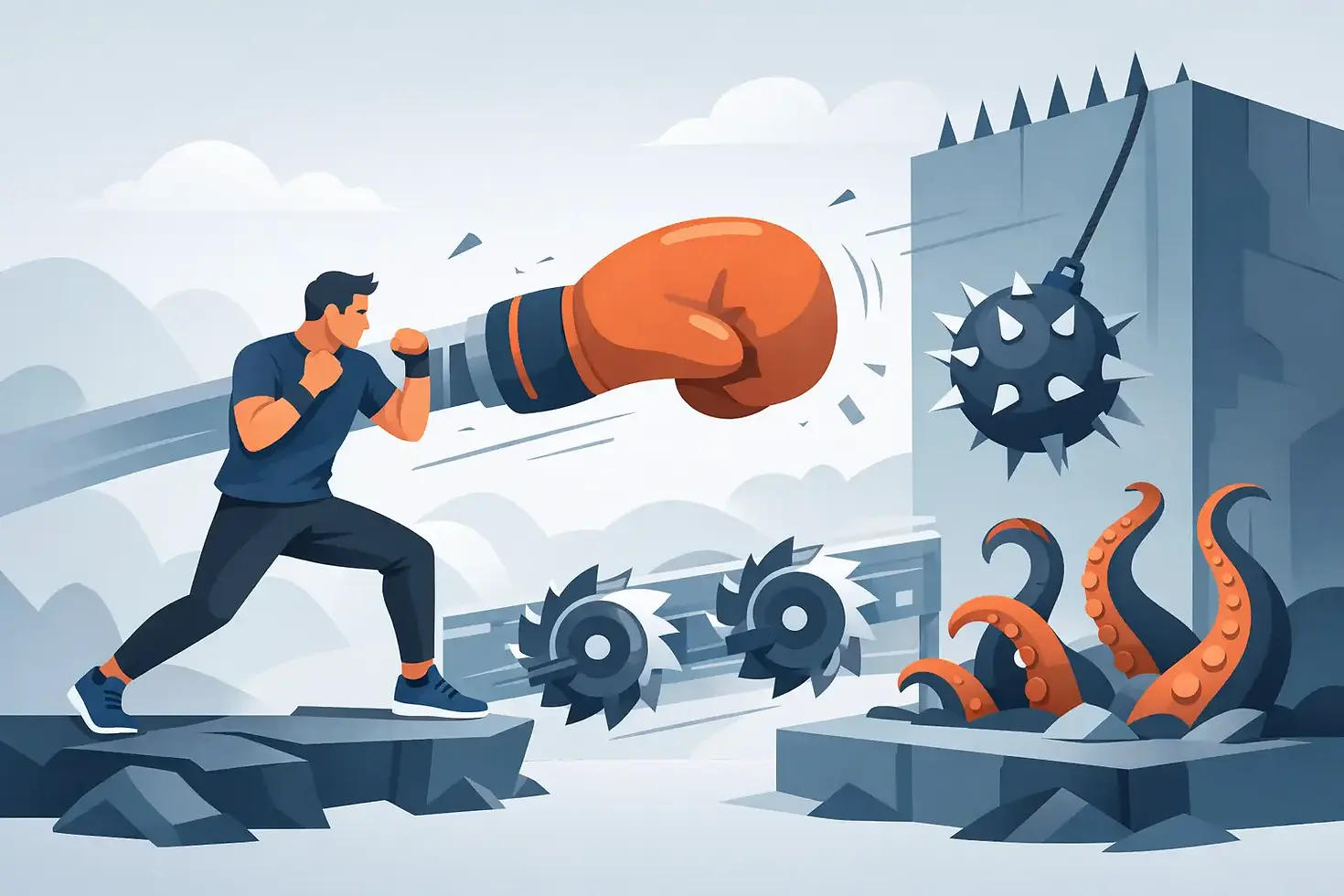
How to Train for Obstacles That Fight Back
You do not train for obstacles the same way you train for a treadmill. Obstacles ask your body to pull, hang, jump, land, balance, react, and keep going when your grip starts to fade and your brain wants a reset. If you want to learn how to train for obstacles, stop thinking only about workouts and start thinking about movement skills under pressure.
That shift matters. A lot of people are stronger than they look on paper, but still struggle on monkey bars, warped walls, rings, ropes, and balance obstacles. Why? Because obstacle training is not just about raw strength. It is about timing, coordination, body control, and confidence when things get awkward fast.
How to train for obstacles without wasting effort
The biggest mistake beginners make is training hard but training too narrow. They do endless push-ups, run a few miles, maybe add some curls, and expect that to carry over. It helps a little, but obstacles punish weak links. If your grip fails, your upper-body strength does not matter much. If your feet are slow, your power does not show up at the right moment. If your core is loose, every swing and landing gets harder.
Good obstacle training builds five things at once: grip, pulling strength, lower-body power, balance and coordination, and work capacity. Miss one of those, and you will feel it.
The good news is you do not need to be elite to start. Kids, teens, adults, and active families can all improve quickly because obstacle skills respond well to smart practice. Progress usually comes from better movement, not just harder workouts.
Start with movement patterns, not random exercises
Before you worry about advanced obstacles, build the patterns they rely on. Can you hang comfortably? Can you pull your body with control? Can you jump and land softly? Can you move sideways without looking lost? Can you keep your trunk stable while your arms and legs do different jobs?
Those are the basics.
A simple week of training usually works best when it includes one day focused on upper-body pulling and grip, one day focused on lower-body power and agility, and one day that blends skills with endurance. If you can train four days, add a technique day with lower intensity and more repetition. That setup gives you enough frequency to improve without frying your hands and shoulders.
Build grip strength that lasts past the first obstacle
Grip is where most obstacle runs get real. You can feel amazing for ten minutes, then hit one hanging obstacle and suddenly your forearms are on fire. That is normal. Grip fatigue builds fast because many people do not train it directly.
Dead hangs are one of the best places to start. Hang from a bar with active shoulders, ribs down, and a steady breath. Short sets done consistently beat one all-out hang with sloppy form. Once that gets easier, mix in towel hangs, ring hangs, and side-to-side bar movement.
Carries help too. Farmer carries, suitcase carries, and sandbag holds teach your hands and trunk to stay engaged while the rest of your body moves. The carryover is strong because obstacles rarely happen in a perfectly controlled position.
It depends on your level, but more is not always better here. If your skin is torn up or your elbows feel cranky, your grip session went too far. Obstacle athletes need durable hands and healthy joints, not just exhausted forearms.
Pulling strength matters more than mirror muscles
If your goal is obstacle performance, train your back more than your chest. Pull-ups, assisted pull-ups, rows, rope pulls, and controlled descents all matter. Even if you cannot do a full pull-up yet, you can build the pattern with ring rows, band assistance, and negative reps.
Think about two types of pulling. One is vertical, like climbing or getting over something. The other is horizontal, like rowing your body through space or stabilizing during awkward transitions. You need both.
Tempo helps. Fast reps look impressive, but slow controlled reps build position awareness. That becomes a big advantage when you have to adjust in the middle of an obstacle instead of just muscling through it.
Train your legs for takeoff, landing, and repeat effort
Obstacle training is not all upper body. Your legs drive you into and over almost everything. They also protect you on landings and keep you moving between obstacles.
Squats, lunges, step-ups, and split squats build useful strength. Box jumps, broad jumps, and quick low-level hops build power and reactivity. Sled pushes, hill sprints, and short shuttle runs build the kind of engine that actually feels useful in obstacle training.
Do not chase jump height before you own landing mechanics. If your knees cave in, your heels slam the floor, or your trunk folds forward every time you land, clean that up first. Smooth landings save energy and lower injury risk.
For kids and beginners, footwork drills can be just as valuable as heavy strength work. Quick feet, direction changes, and balance challenges build body awareness fast. For advanced athletes, the focus shifts more toward power output and efficient transitions.
How to train for obstacles with better coordination
This is where obstacle training gets fun. Coordination is the difference between looking strong and moving strong.
You build it by practicing movement combinations that force your body to solve problems. Swing to a platform, hop to a balance beam, drop to a crawl, then pop up into a short sprint. That kind of sequence teaches your brain and body to stay organized while changing positions.
Balance work matters more than people think, especially when fatigue kicks in. Slacklines, balance beams, single-leg holds, and lateral movement drills all help. The goal is not to become a circus act. The goal is to stay calm and efficient when your base of support gets small.
Reaction work helps too. If you only train predictable patterns, real obstacles can surprise you. Add drills where you respond to a visual cue, change direction, or choose between two movement options. That decision-making piece is often what separates confident athletes from hesitant ones.
Practice technique when you are fresh
Strength and conditioning can raise your ceiling, but skill work raises your success rate. If you want to improve on walls, rings, ropes, or monkey bars, practice those movements early in the session before fatigue wrecks your timing.
Keep the reps clean. A few quality attempts teach more than a pile of ugly ones. If your technique falls apart, lower the difficulty instead of forcing bad habits. Use assistance, reduce distance, slow the tempo, or break the skill into parts.
This is one reason obstacle gyms work so well. You get to train the actual challenge, not just the muscles behind it. If you are in Lancaster or nearby, training in a dedicated obstacle environment like Go Ninja can speed up progress because you can practice real movement patterns instead of guessing from a standard gym floor.
Do not ignore endurance, but train it the right way
Steady cardio has value, but obstacle endurance is different from jogging at one pace. You need to recover quickly between bursts, control your breathing under stress, and keep moving after spikes in effort.
Interval training usually makes more sense than long, slow sessions alone. Try short runs mixed with crawls, carries, hangs, jumps, and bodyweight movements. That teaches your system to switch gears without shutting down.
Still, there is a trade-off. If every session turns into a max-effort circuit, your skills and strength may stall. Use conditioning to support obstacle training, not replace it.
Recovery is part of the program
People get excited about obstacles and forget that hands, elbows, and shoulders need respect. Recovery is not lazy. It is what lets you train again with quality.
Pay attention to sleep, hydration, and basic mobility. If your forearms are constantly tight, your swing mechanics and grip endurance will suffer. If your shoulders never feel fresh, hanging work gets ugly fast. A little soft tissue work, mobility, and smart rest days can keep your progress moving.
Beginners usually need less volume than they think. Advanced athletes often need more structure than they think. Either way, soreness is not the goal. Better movement is.
A simple way to structure your week
If you are wondering how to train for obstacles in a practical way, keep it simple enough to repeat. One day can focus on grip and pulling. Another can focus on legs, jumps, and agility. A third can focus on obstacle skills and short conditioning intervals. If you want a fourth day, make it low-intensity technique work, mobility, or active recovery.
That approach gives you enough variety to cover the full demand of obstacle training without turning every workout into chaos. Over time, you can scale difficulty by adding hanging time, harder transitions, faster footwork, or more complex combinations.
The real win is consistency. You do not need to crush one heroic workout. You need enough good sessions that your body starts treating obstacles like a challenge it recognizes instead of a surprise it fears.
Obstacles are supposed to test you. That is what makes them fun. Train your grip, build real pulling strength, move your feet better, practice skills while you are fresh, and give recovery the respect it deserves. Then show up ready to try again. Confidence does not come from waiting until you feel ready. It comes from training until the obstacle stops feeling bigger than you.


Comments