
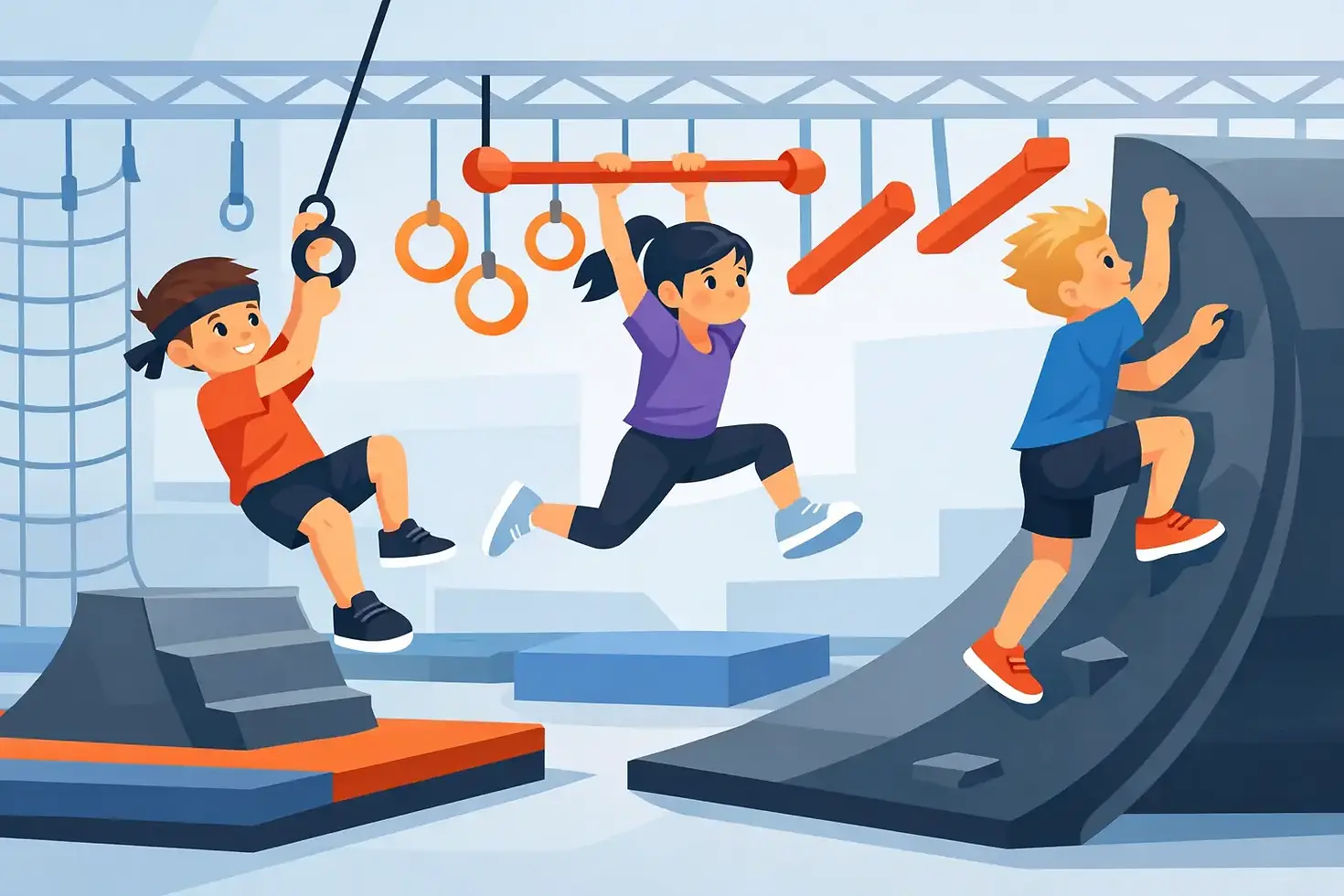
Ninja Warrior Training for Kids That Sticks
Some kids light up the second they see a wall to climb, rings to swing from, or obstacles to race across. They do not want another lecture about exercise. They want movement that feels like play, progress they can actually see, and a challenge worth chasing. That is exactly why ninja warrior training for kids has become such a strong fit for families who want more than another routine sports program.
What makes it different is simple. Kids are not just being told to run laps or repeat drills without context. They are working toward something exciting. One week it is getting across monkey bars without dropping. The next it is learning how to control a landing, move faster through an obstacle lane, or build the grip strength to hang a little longer. The workout happens almost by accident, but the results are very real.
Why ninja warrior training for kids works so well
A lot of youth fitness programs struggle because kids get bored fast. If the activity feels repetitive or overly rigid, motivation disappears. Ninja-style training flips that pattern. It gives kids a clear challenge, immediate feedback, and a reason to keep trying.
Obstacle-based training pulls together strength, coordination, agility, balance, endurance, and body awareness in one session. That matters because kids do not develop fitness in isolated pieces. They move as a whole body. Climbing, swinging, jumping, crawling, and landing all demand multiple skills at once, which makes the training feel natural and exciting.
There is also a mental side that parents notice quickly. Kids learn patience when they cannot beat an obstacle on the first try. They learn problem-solving when one approach does not work. They learn confidence when they finally clear something that seemed impossible ten minutes earlier. Those wins stick.
The real benefits go beyond burning energy
Yes, this kind of training helps active kids burn off steam in a healthy way. But the bigger value usually shows up in how they carry themselves afterward.
Kids who train on obstacles often improve their grip strength, core strength, coordination, and reaction time. Those physical gains support performance in other sports too, from soccer and baseball to gymnastics and martial arts. Better body control helps almost everywhere.
Just as important, they start trusting their bodies more. A child who once hesitated to jump to a platform may begin taking on new challenges with much less fear. That confidence can carry into school, sports, and social situations. It is not magic, and every child progresses at a different speed, but the pattern is common.
There is a trade-off, though. Ninja training is not meant to replace every other activity. Some kids still benefit from team sports, free play, or sport-specific coaching alongside obstacle work. The best fit depends on the child. For some, ninja training becomes their main activity. For others, it is the perfect complement that fills in strength, coordination, and confidence gaps.
What kids actually do in training
Parents sometimes hear the phrase and picture kids being thrown onto advanced obstacles with no structure. Good training is not like that.
A strong program starts with movement fundamentals. Kids learn how to warm up, how to hold their bodies under tension, how to land safely, and how to move with control before speed takes over. From there, they build skill by skill.
Strength and grip
Hanging, climbing, traversing, and carrying all challenge the upper body and core. Grip strength becomes a major focus because it affects so many obstacles. Kids usually do not think of it as strength work. They just know they want to make it farther across.
Agility and footwork
Quick direction changes, balance elements, short sprints, and precise steps teach kids how to move efficiently. This is where awkward movement often starts to smooth out. Over time, many kids become faster because they are becoming more coordinated, not just more aggressive.
Balance and control
Balance obstacles reveal a lot. They show whether a child can stay calm under pressure, shift weight properly, and recover without panicking. Those skills take time, but they are valuable because they improve body awareness in a big way.
Problem-solving under pressure
Not every obstacle is about brute force. Kids learn to read spacing, timing, and momentum. Sometimes the strongest child in the group is not the first to finish. The one who stays calm and adjusts often wins that round.
Is ninja warrior training right for every child?
Usually, it works best for kids who like movement, challenge, and variety. That includes the obvious high-energy kids, but not only them. Some quieter kids thrive here because progress is personal. They are not always being compared by points on a scoreboard. They can work at their own level, build confidence, and celebrate milestones that matter to them.
For kids who are brand new to fitness, the right coaching matters a lot. A beginner should not feel like they have to perform at an advanced level on day one. They need a setting that is welcoming, structured, and encouraging. The goal is not perfection. The goal is progress.
Parents should also think about temperament. If a child gets frustrated easily, ninja training can still be a great fit, but they may need extra coaching around patience and persistence. Obstacles have a way of exposing frustration quickly. That is not a bad thing when the environment helps kids work through it.
What parents should look for in a program
Not all kids programs are built the same, and this is where quality matters.
Look for coaches who know how to scale obstacles by age, size, and experience level. A good class should challenge kids without setting them up to fail. Safety instruction should be part of the training, not an afterthought. Kids should be learning how to fall, land, grip, and approach obstacles with control.
You also want a program that keeps the fun factor high. If the session feels like punishment disguised as fitness, kids will check out. The best training environments keep energy up while still teaching real skills. That balance is what makes them effective.
Community matters too. When kids train around others who are cheering them on, trying hard, and learning together, the room feels different. It feels positive. It feels motivating. That kind of environment can make a huge difference, especially for kids who need encouragement to stay active.
At Go Ninja, that challenge-meets-fun energy is exactly the point. Kids get the thrill of obstacle-based movement in a setting built to help them grow stronger, more confident, and more capable one attempt at a time.
How often should kids train?
It depends on age, recovery, and what else is on their schedule. For many kids, one to two sessions a week is enough to build skills and keep enthusiasm high. If they are also playing sports, that may be the sweet spot. More is not always better if they are already overloaded.
Consistency matters more than intensity. A child who trains regularly, stays engaged, and keeps improving movement quality will usually do better than one who goes all-out for a week and burns out. The goal is to make fitness something they want to come back to.
Parents can support that by focusing on effort instead of only outcomes. If your child tried a harder obstacle, held on longer, or got back up after missing, that counts. Progress in ninja training is often measured in small breakthroughs before it shows up in big ones.
Why kids keep coming back
The best part of ninja training is that success feels earned. Kids remember the obstacle that beat them last week. They remember the first time they made it across something difficult. They remember the coach or teammate who told them to try again. That sense of progress creates real buy-in.
It is also one of the few fitness experiences that feels equally exciting to a wide range of kids. Some love the speed. Some love the climbing. Some love beating their own best time. Some just love that exercise finally feels fun.
When a program gives kids a challenge, a place to improve, and a reason to believe they can do hard things, it becomes bigger than a workout. It becomes part of how they build confidence. And for a lot of families, that is the kind of win worth chasing.
If your child is ready for something active, exciting, and a lot more engaging than another ordinary workout, ninja training gives them a chance to move with purpose and surprise themselves in the process.


Comments