
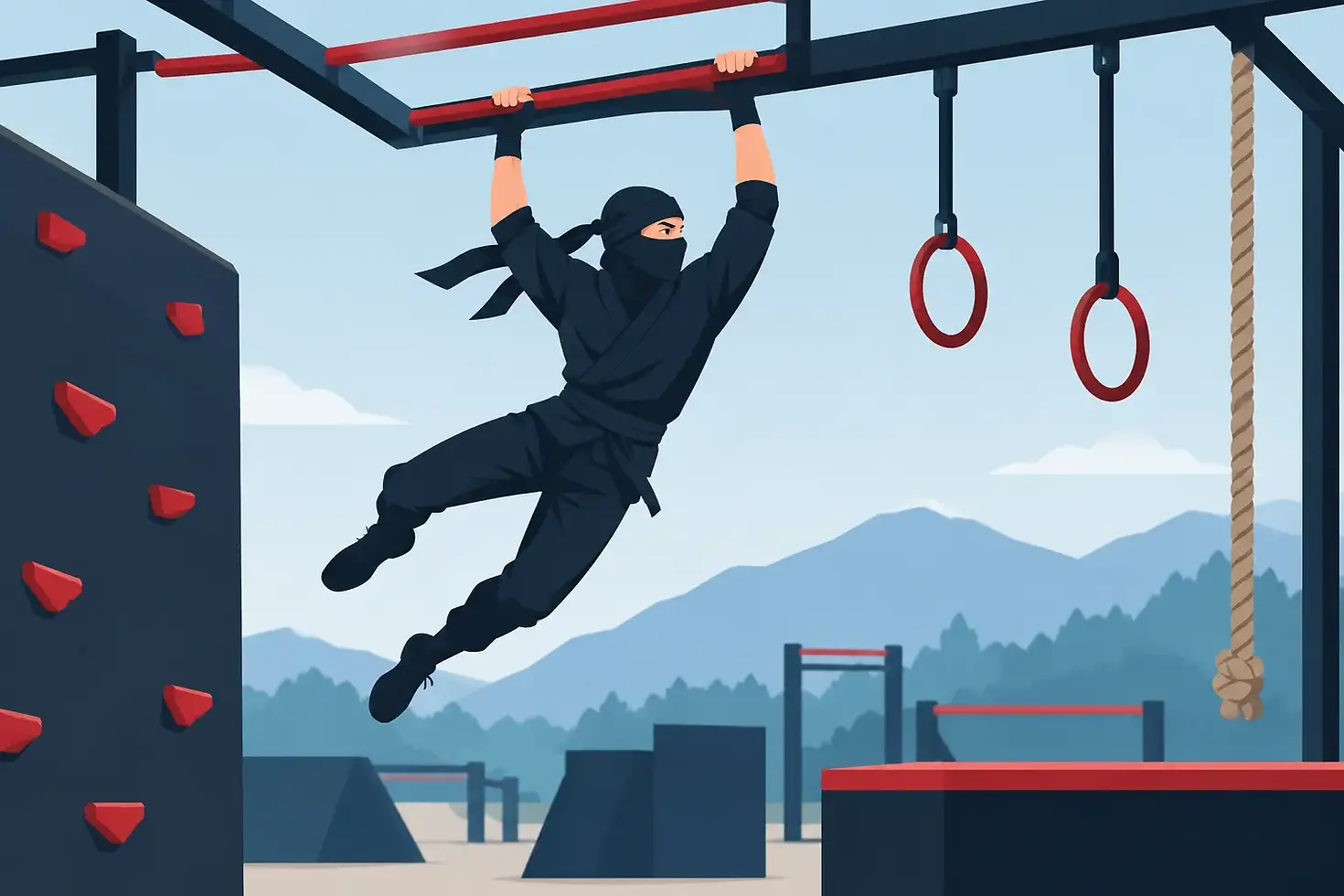
A Guide to Upper Body Obstacles for Ninjas
The moment your feet leave the floor, the obstacle changes. A guide to upper body obstacles is not just about getting stronger enough to hang from a bar. It is about learning how to control your body, protect your shoulders, manage your grip, and stay calm when the next hold is just out of reach.
That is what makes Ninja-style training so addictive. Every swing, ledge, ring, and wall asks you to solve a movement problem under pressure. You do not need to arrive with perfect pull-ups or competition-level skills. You just need a willingness to start where you are and work the challenge one move at a time.
What Counts as an Upper Body Obstacle?
Upper body obstacles are any challenges where your hands, arms, shoulders, back, and core do most of the work. They may include hanging bars, rings, monkey bars, cliffhangers, cargo nets, ropes, swinging obstacles, and traverse walls. Some demand a big pull. Others require careful balance, timing, and a grip that refuses to quit.
The biggest surprise for beginners is that upper body obstacles are rarely only about the upper body. Your core keeps you from swinging wildly. Your hips help you generate momentum. Your legs can tuck, kick, or press against a surface to save energy. The strongest athletes still struggle if they waste movement.
For younger Ninjas especially, skill development matters more than brute force. A child who learns to hang with active shoulders, reach with control, and land safely is building a foundation that carries into every harder obstacle later.
The Three Skills That Make Obstacles Feel Easier
Grip endurance
Your grip is often the first thing to give out. Fingers, hands, and forearms work hard on every hanging obstacle, especially on narrow bars, rings, or ledges. But grip training is not about squeezing as hard as possible from the first second. It is about holding efficiently.
Keep your hands secure without clenching your entire body. When appropriate, adjust your grip before it becomes desperate. On a traverse, move with purpose instead of stopping too long at every hold. Hanging still can be tougher than moving because time under tension adds up fast.
Build grip gradually. Short hangs, dead hangs with feet available for support, monkey bar traverses, and farmer carries all help. If your hands hurt sharply, your elbows ache, or your grip fails every time, reduce the difficulty and build back up. Tough hands take time.
Pulling strength
Pulling strength powers upward movement. It helps you move from one bar to the next, pull over a ledge, climb a rope, and recover when a swing does not go exactly as planned. Pull-ups are useful, but they are not the only measure of Ninja strength.
Rows, assisted pull-ups, slow negatives, rope pulls, and hanging scapular shrugs all build the muscles that support obstacle movement. Scapular control means being able to engage the muscles around your shoulder blades rather than letting your shoulders hang loose by your ears. It may not look flashy, but it makes hanging safer and more powerful.
If you cannot do a full pull-up yet, that is not a reason to skip upper body obstacles. Use a lower bar, a resistance band, a coach's progressions, or a foothold. Training the movement with good form beats forcing a rep with poor control.
Swing and body tension
A clean swing can carry you farther than an extra pull-up. On rings, lache bars, and other swinging obstacles, your body should move as one connected unit. Think long through the arms, tight through the core, and intentional through the hips.
The basic pattern is simple: create a controlled swing, look toward your next target, release only when your body has the right direction, and catch with shoulders ready to absorb the force. The timing is not always simple, which is why repetition matters.
Avoid throwing your body around just to create bigger movement. A giant, uncontrolled swing can make the catch harder and tire your grip faster. Start with smaller swings until you can predict where your body will be at the release point.
A Guide to Upper Body Obstacles: Start With Technique
Upper body obstacles reward smart movement. Before you attack a new challenge, take a few seconds to study it. Where will your hands go? Is the next hold high, far, narrow, rotating, or slippery? Will you need to swing, pull, traverse sideways, or climb over?
Then identify the easiest version of the movement. That may mean using a lower bar, practicing only the first two rings, starting with a spotter, or keeping your feet on a box while learning the hand pattern. There is no prize for skipping the progression that would have helped you succeed.
For most obstacles, these habits make a real difference:
Keep your shoulders active instead of collapsing into a loose hang.
Use your eyes. Look at the hold you plan to catch, not at the floor.
Keep your core engaged so your legs do not swing in every direction.
Breathe. Holding your breath makes fatigue feel worse and can make you rush.
Know when to drop safely rather than forcing a bad catch.
That last point is part of training like a Ninja. Falling safely onto proper padding, when instructed by a coach, is a skill. A controlled drop is better than fighting through a painful grip slip or twisting to make an impossible save.
Common Upper Body Obstacles and How to Approach Them
Monkey bars look familiar, but they challenge coordination as much as strength. Beginners often reach one hand at a time and pause too long. Try to develop a smooth rhythm. As one hand reaches, the other prepares to release. Keep your body moving forward rather than hanging underneath each rung.
Rings add instability. Since they move independently, they can pull your shoulders and body out of position. Start by practicing a stable hang, then small swings, then controlled reaches. A ring-to-ring transfer requires commitment, but not panic. Reach when the ring is traveling toward the direction you want to go.
Cliffhangers and ledges test finger strength and patience. Keep your arms slightly bent when possible, use your feet against the wall if the obstacle allows it, and avoid overgripping at the start. On these obstacles, efficient foot placement can save your forearms.
Ropes ask for a combination of pulling strength, grip, and leg technique. Your legs are not passengers. Learn a foot lock or clamp from a qualified coach so your lower body can take some of the load. Trying to muscle your way up entirely with your arms gets exhausting quickly.
Cargo nets can feel easier because there are many places to grab, but they still require planning. Move diagonally when it helps, keep three points of contact when learning, and avoid stepping onto sections that shift unexpectedly. Speed comes after control.
Train Hard Without Training Reckless
Obstacle training should challenge you, not beat you up. Hands can blister, forearms can fatigue, and shoulders can get irritated when volume rises too fast. A little soreness after a new workout can be normal. Sharp pain, joint pain, numbness, or pain that changes how you move is a signal to stop and get guidance.
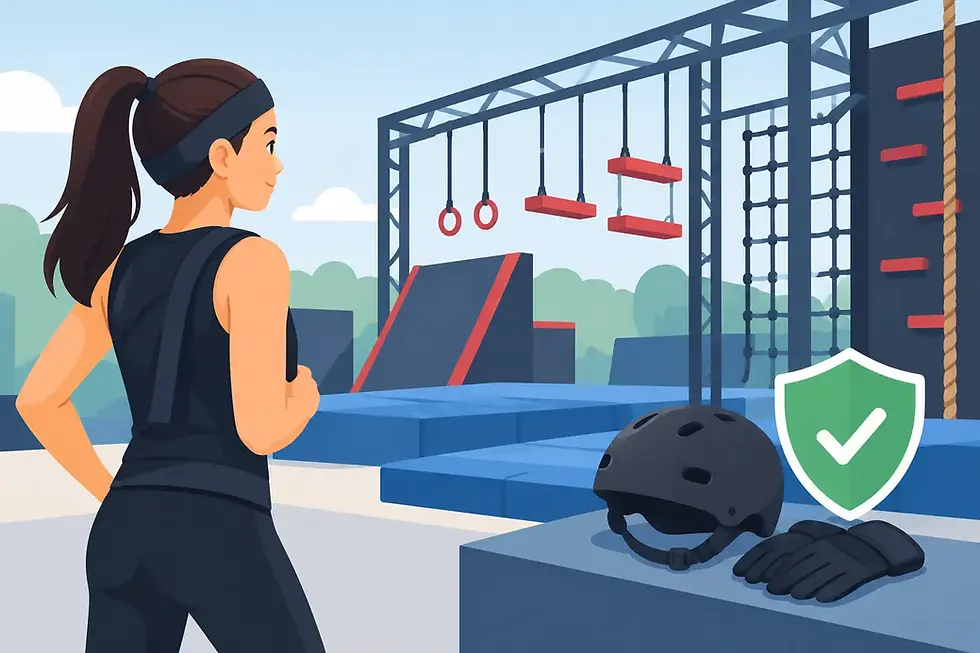
Warm up your wrists, shoulders, elbows, and upper back before hanging. A few arm circles are not enough if you are about to spend an hour on bars and rings. Use light hangs, shoulder activation, easy traverses, and gradual swings before trying the biggest obstacle in the gym.
Recovery matters too. Give your hands and pulling muscles time to recover, especially after hard grip sessions. If you train upper body obstacles several times a week, alternate hard days with technique-focused days. On the lighter days, work footwork, balance, mobility, or movement patterns instead of repeatedly testing your max hang time.
Build Confidence One Catch at a Time
Confidence does not come from pretending an obstacle is easy. It comes from collecting proof that you can handle the next step. First, you hold the bar for ten seconds. Then you cross two rungs. Then you make it halfway across. Soon, the obstacle that once looked impossible becomes your warm-up.
At Go Ninja, that progression is part of the fun. Kids, teens, and adults can train in the same high-energy environment while taking on versions of challenges that match their current ability. The goal is not to copy someone else's pace. The goal is to leave stronger, braver, and ready to try again.
Your next upper body obstacle does not need a perfect attempt. It needs a focused one. Set your hands, engage your shoulders, commit to the next move, and let every catch teach you what to do next.

Comments